â€å“to Resolve a Conflict First Decide Is It Hot or Cold?ã¢â‚¬â Harvard Business Review
Nurse managers piece of work in environments in which disharmonize often arises and can be difficult to resolve. This report explored how diverse backgrounds amid nurse managers influenced their disharmonize management styles. A full of 321 nurse managers, working in referral hospitals in the Sultanate of Sultanate of oman, were surveyed using an adjusted version of the Rahim Organizational Conflict Inventory 2 (ROCI-Two) calibration, and a response rate of 271 (86%) was obtained. Data were analyzed using the SPSS statistical package. The 1-sample Kolmogorov– Smirnov examination was used to determine the disharmonize management styles used by nurse managers. A nonparametric Spearman's rho exam was used to determine whether there was whatever relationship between age and number of years of experience and conflict direction style. The Mann–Whitney U-test was used to compare male and female managers with regard to conflict management styles. The findings indicated that conflict management styles varied according to the nationality, gender, age, marital condition and number of years of feel of the nurse managers. In addition, the grade and education level of nurse managers played a office in conflict management. These findings take implications for policy makers and nurse managers in helping them to understand the result of diverse nursing backgrounds on conflict direction, and the demand to develop new approaches with regard to disharmonize management styles.
What is known on this bailiwick
• In daily nursing work, conflict is inevitable.
• The disharmonize management styles used by nurse managers take an important issue on their operation.
• Effective conflict direction promotes motivation, enhances morale and promotes individual and organisational growth.
What this paper adds
• Courses in conflict direction should exist available for all nurses, and especially for the nurse manager.
• Prior training that focuses on cultural factors must exist given to non-national nurse managers before they arrive in Arab countries.
• Research is needed to establish the cultural meanings of the five disharmonize management styles.
Central words
Arab countries, conflict management, Ibadhiyah, nurse managers, Oman
Introduction
Nurse managers piece of work in environments in which conflict is probable to arise due to both the nature of their work and the demand to collaborate with a wide range of individuals. Although the management of disharmonize has been studied previously, no research has examined the conflict direction styles of nurse managers in Sultanate of oman or any other Arab country. The present study sought to accost this outcome past examining the conflict management styles used by nurse managers in the Sultanate of oman, with the aim of increasing understanding of the behaviour of nurse managers from different backgrounds, and their ability to deal with conflict.
Background to Sultanate of oman
The Oman is located in the south-eastern corner of the Arabian Peninsula. The total Sultanate population is 2 508 837, and the country's coastline extends for 1700 kilometres, from the Strait of Hormuz in the North to the borders of the Republic of Republic of yemen. Agriculture and angling are the traditional occupations in Oman, and 40% of the labour force is involved in agronomics or trade. Oil is considered to be the principal source of income in Oman (Ministry of National Economy, 2004).
The results of the 2003 census (Ministry building of National Economy, 2004) showed that the male person:female ratio is 128:100 in the population as a whole, and 102:100 among Omani nationals. In ethnic terms, the population is predominantly Arab, with significant minorities of Indians, Pakistanis and E Africans, mostly living in the principal ports. In terms of religion, the majority (effectually 55%) of the population is Ibadhi Muslim, and Sunni Muslims form the other major religious group. Arabic is the official language, just English is widely used every bit a second language.
Ibadism, a distinct sect of Islam that is neither Sunni nor Shi'i, exists mainly in Oman, East Africa, the Mzab valley of Algeria, the Nafus mountains of Libya, and the island of Jerba in Tunisia. Ibadi communities are more often than not regarded as bourgeois. Sunni Muslims traditionally regard the Ibadiyya as a khariijite grouping, but Ibadis reject this designation. Ibadis regard other Muslims non every bit kafir (unbelievers), just every bit kuffar annima (those who deny God'southward grace). Ibadi beliefs differ in several respects from those of Sunni Muslims, master among them being that:
• Muslims will non see God on the day of Judgement
• whosoever enters the Hellfire, will live therein forever
• the Qur'an was created past God at a certain betoken of fourth dimension.
Subdivisions of the Ibadhiyah include the following sects: Al-Wahbiyah, Al-Nukkar, Khalafiyah, Al- Naffathiyah, Al-Husainiyah, Al-Sakakiyah, Umairiyah and Al-Farthiyah (Ennami, 1996).
The rapid growth of healthcare services has led to an increasing demand on the medical and nursing workforce. During the last three decades, the number of nurses working inOmanas a proportion of the full general population has increased dramatically from v.half dozen per ten 000 in 1975 to 31.v per 10 000 in 2005 (Ministry building of Health, 2006). The nursing profession is the fastest growing wellness profession in the country. In 1975 at that place were just 450 nurses working for the Ministry of Wellness (MOH), merely this figure rose to 7909 in 2005, and 59% of these nurses were Omani (Ministry of Health, 2006). In full, 743 nurses were male and the rest were female person. TheMinistry ofHealth employs 2981 doctors, of whom 29% are Omani and 64% are male.
Literature on conflict direction
Conflict is a natural and pervasive phenomenon in homo feel (Pondy, 1967;De Dreu and Van De Vliert, 1997; Jameson, 1999; Tengilimoglu and Kisa, 2005). It is a part of people's lives in organisations also as being a part of domestic life. Indeed, it is inevitable, especially in a highly stressful surround (Shockley-Zalabak, 1981; Forte, 1997; Jameson, 1999; Hurst and Keenan, 2000, Tengilimoglu and Kisa, 2005). The management of conflict is extremely important both for the effective functioning of organisations and for the personal, cultural and social evolution of individuals. The term conflict direction strategy is used to describe any action that is taken past a disputant or a third party tomanage or resolve a conflict (Jameson, 1999). Effective conflict management is a vital skill that can exist learned (Bartol et al, 2001).
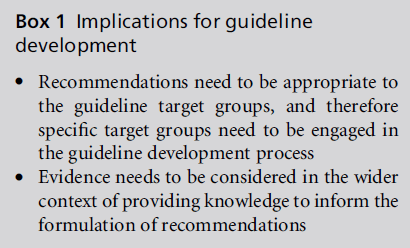
Blake and Mouton (1964) were the first to formalise a framework for managing organisational conflict. They developed a managerial grid composed of v basic styles of management that characterise an private's likely behaviour in a disharmonize situation (see Box 1). The filigree model consists of two measurable dimensions which accept the greatest effect on the way that people piece of work, namely concern for production and concern for people. Product is 'whatever an organisation hires people to achieve' (Blake and Mouton, 1985, p. ten). Disharmonize management is as well a function of high or low levels of concern for self, combined with high or low levels of concern for others (De Dreu et al, 2001)
The five ways of handling conflict can exist defined as avoiding, compromising, integrating, obliging and dominating (Blake andMouton, 1964; Thomas and Kilmann, 1974; Rahim, 1983; De Dreu et al, 2001).
Fugitive conflict results from low levels of business organization for the self and others. Information technology involves reducing the importance of the bug, and attempting to suppress thoughts about them (Keenan et al, 1998). In avoiding conflict the individual only refuses to address it, and is unassertive and uncooperative. Conflict abstention is particularly appropriate when the other political party is more powerful (McElhaney, 1996; De Dreu et al, 2001; Tabak and Koprak, 2007).
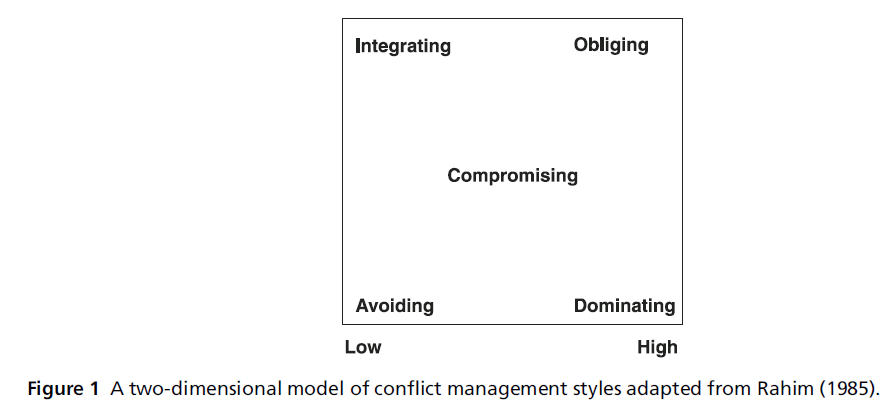
Effigy 1 :A two-dimensional model of disharmonize management styles adapted from Rahim (1985).
Compromising when faced with conflict results from moderate concern both for oneself and for others. It involves intermediate levels of both assertiveness and cooperation. This arroyo focuses on quick, mutually agreeable decisions that partially satisfy both parties (Rahim, 1983). Compromising emerges when there is negotiation and exchange. Each person gains something but also gives up something else in the process.
Integrating or collaborative approaches to dealing with conflict involve ane party working with the other to find a solution that satisfies both parties. Integrating confronts issues and arises from high levels of business organisation for the cocky and others. It is both assertive and cooperative, and involves an attempt to piece of work with the other person to find a solution that fully satisfies the concerns of both parties. This approach leads to mutually satisfying decision making (Marriner, 1982; Vivar, 2006).
Obliging or all-around approaches to managing conflict result from low levels of concern for oneself and high levels of concern for others. These approaches are orientated towards accepting and incorporating the other party'due south volition, and thus involve unilateral concessions, unconditional promises and offers of help. All-around is characterised past cooperative merely unassertive behaviour. The all-around individual exhibits cocky-sacrificial behaviour by neglecting his or her own concerns in order to satisfy those of the other person (Marriner, 1982; McElhaney, 1996; Valentine, 2001; Tabak and Koprak, 2007).
Dominating or forceful approaches to managing conflict focus on imposing one's volition on others through threats and bluffs, persuasive arguments and power. Dominating is an ambitious, uncompromising arroyo to disharmonize. It is power-driven, and the individual pursues his or her own personal goals without regard for others (McElhaney, 1996; Valentine, 2001; Vivar, 2006).
Conflict management in nursing
Conflict in nursing is frequently described in terms of the relationship between two occupational groups, such every bit physicians and nurses, staff nurses and nurse managers, or two dissimilar departments (Hendel et al, 2005; Vivar, 2006; Tabak and Koprak, 2007). Managing such conflict makes a crucial contribution to the effective functioning of nursing organisations, and consequently to the excellence of nursing care (Vivar, 2006). An individual's cultural and family traditions, personality and life experience all shape the ways in which he or she handles conflict (Campbell, 2003). There has been no research examining how nurses in Oman manage conflict, which styles of conflict management they use and why.
Aims of the report
The study reported here is role of a much larger project with the post-obit aims:
• to explore and compare the conflict management styles used by nurse managers in the Sultanate of oman
• to identify the roles of civilisation, gender, and other variables related to nurse managers working in the Sultanate of Oman, in disharmonize management
• to add to existing noesis in this area of work.
This paper presents a report of a survey of conflict management styles used by nurse managers in Sultanate of oman.
Report design
A survey methodology was adult based on an adapted version of the Rahim Organisational Conflict Inventory 2 (ROCI-II) (Rahim, 1983). This tool was adult from a sample of 1219 American managers from different management levels and sectors. Of these, 185 were infirmary management personnel (Rahim, 1983). ROCI-Ii is valid and reliable. It is used internationally, including in Middle Eastern countries (Kramer, 1989; Elsayed-Ekhouly and Buda, 1996; Kozan and Ergin, 1999; Kozan, 2002; Boonsathorn, 2003). The tool consists of 28 items, presented using a 5-signal Likert scale (where 5 = strongly agree and 1 = strongly disagree), that reflect conflict management styles based on private disposition. These items cover the 5 styles as follows: items 2, four, 5, 12, 22, 23 and 28 cover integrating styles; items 1, 10, thirteen, 17, 19 and 24 cover obliging styles; items 6, 9, eighteen, 21 and 25 cover dominating styles; items 7, 8, 11, 16, 26, and 27 encompass avoiding styles; items iii, fourteen, 15 and twenty comprehend compromising styles. The five conflict direction styles reflect dissimilar combinations of concern for self and concern for others (Rahim, 1983). The tool was adapted in that some words in the tool were changed and so equally to be more advisable to an Arab culture, and some complex terms were altered to facilitate ease of understanding.
Data collection and analysis
The study was introduced to the head of the nursing department in each participating hospital. The head of nursing distributed the survey to their nurse managers and the researcher collected the completed questionnaires from the nursing role at an agreed later date.
A data analysis programme was adult to guide the analysis of the study. This was derived from the inquiry questions, the inquiry design, the method of data collection and the level of measurement of the data. The data were coded to ensure anonymity and confidentiality. Before selecting suitable tests, data from the demographic questions were consolidated and coded at the nominal level to facilitate assay. The statistical parcel SPSS was used to aid data analysis. Mean values, standard deviations and percentages were derived for the overall sample, and were categorised by age, gender, nationality, nursing qualifications, and number of years of experience as registered nurses and as nurse managers. Number of years of experience in this post, and level of nursing management were also analysed. Non-parametric tests were employed to determine the relationship between the following variables: age, nationality, marital status and qualifications. The one-sample Kolmogorov–Smirnov test was applied in order to ascertain whether the data were normally distributed. The same testwas besides used to explore the conflictmanagement styles used by nurse managers. A non-parametric Spearman's rho examination was used to make up one's mind whether in that location was whatever relationship betwixt age and number of years of experience with regard to conflict management style. The Mann- Whitney U-test was used to compare male and female managers with regard to disharmonize management styles. The Kruskal–Wallis test was used to test the remaining variables, considering at that place were iii or more ordinal independent variables.
Sample
The population for the survey consisted of the 321 nurse managers in the ix Ministry of Wellness referral hospitals. No exclusion criteria were set, then all nurse managers from different levels and different hospitals were included (come across Tabular array 1).
Ideals
The Research Ethics Committees at De Montfort Academy, UK and the Ministry building of Health, Oman reviewed and approved the study.
Each of the 321 potential participants received a package containing the following:
• a letter of the alphabet introducing the researcher and the project
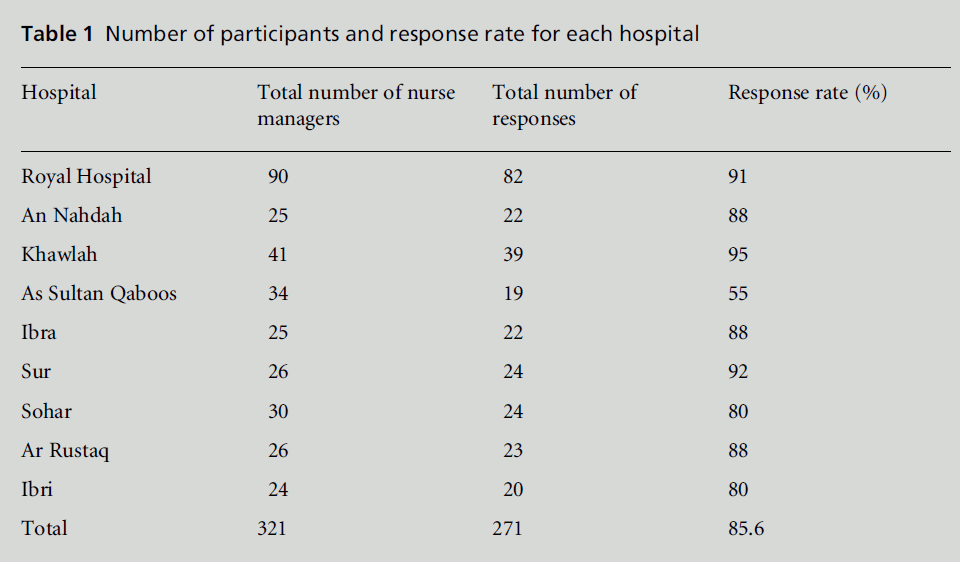
Table ane: Number of participants and response rate for each hospital.
• information for participants
• a consent form
• the research tool plus additional, mainly closed questions about national origin, age, gender, task position, qualifications, and number of years of experience.
Those who elected to take office were asked to sign the consent class, complete the questionnaire, and render both by a specified date. Participation in the study was voluntary, and confidentiality and anonymity were bodacious. Participants were advised of their right to withdraw from the study at any time. To ensure anonymity, the consent form and questionnaires were returned in separate envelopes.
Findings
Sample characteristics
A full of 271 responses were received. Managers in all of the hospitals responded. The highest response rate was from Sur (92%) and the lowest was from Sultan Qaboos (55%) (encounter Table 1). Analysis showed that 80.8% of respondents were female, 79% were married and 15.v% were single. A few were either widowed or divorced. In total, 68.3% of respondents held firstlevel management positions and a further 28.8%were employed at eye management levels (see Table ii).
Disharmonize management styles
Respondents reported using the integrating style as theirfirst choicewhenmanaging conflict.The preference rating for integrating was 4.31%, followed by compromising (3.46%), obliging (three.14%), dominating (2.93%) and avoiding (two.78%) (come across Table 3). At that place was a positive but non-meaning relationship between age and integrating style. Similarly, the relationship between age and the avoiding and compromising styles was negative but non-significant. Notwithstanding, there was a meaning relationship between age and the dominating and obliging styles (P < 0.01 and P = 0.001, respectively).
There was a positive human relationship between the number of years of experience as a registered nurse and the integrating style of conflict management. In contrast, there was a negative human relationship between the number of years of experience every bit a registered nurse and the other 4 styles of conflict direction. Table 4 shows that the relationship between number of years of experience and styles of conflict management is significant, with obliging manner (P<0.001) and dominating style (P = 0.001) beingness associated with older age.
Table 4 demonstrates that number of years of experience every bit a nurse manager has the same relationship with disharmonize management styles. Information technology is positively associated with the integrating style and negatively associated with the other four styles. The relationship between number of years of feel as a nurse managing director and the dominating style was significant (P= 0.035), just this was not significant when using the revised alpha level, and the relationship with the obliging style was even stronger (P = 0.005).
There was no relationship between number of years of experience in the current mail service and integrating style, while the relationship between this gene and compromising style was positive but non-significant. Similarly, there were negative merely non-significant relationships with avoiding, dominating and obliging styles.
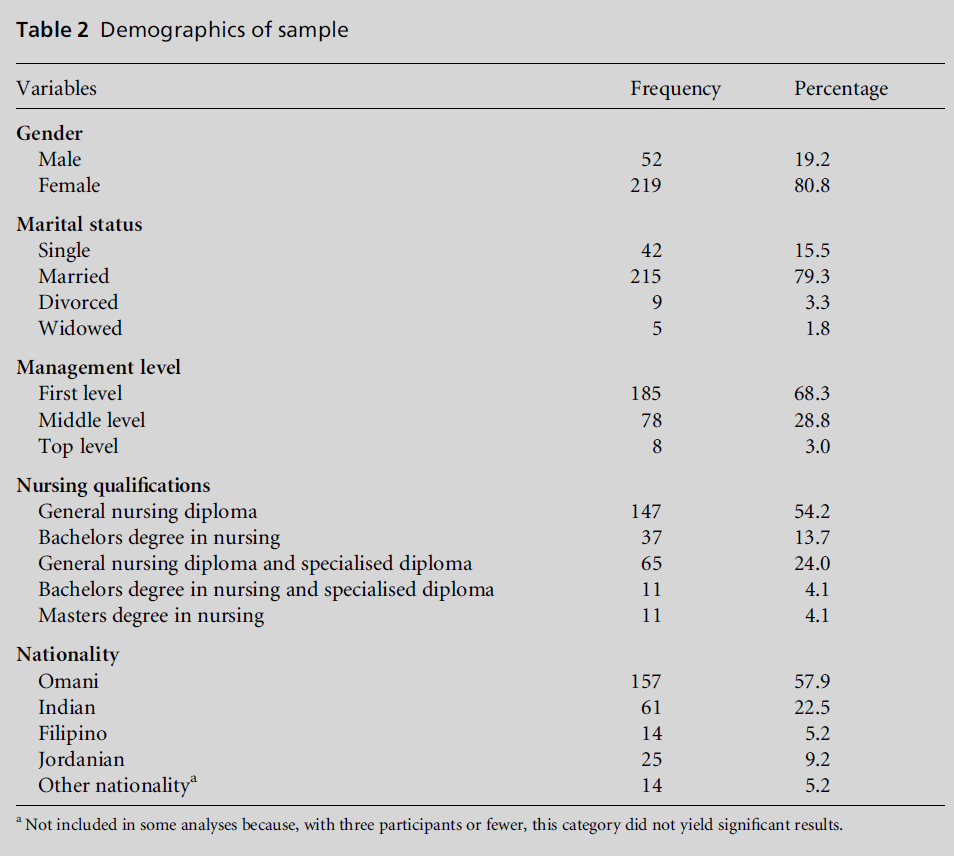
Table 2:Demographics of sample.
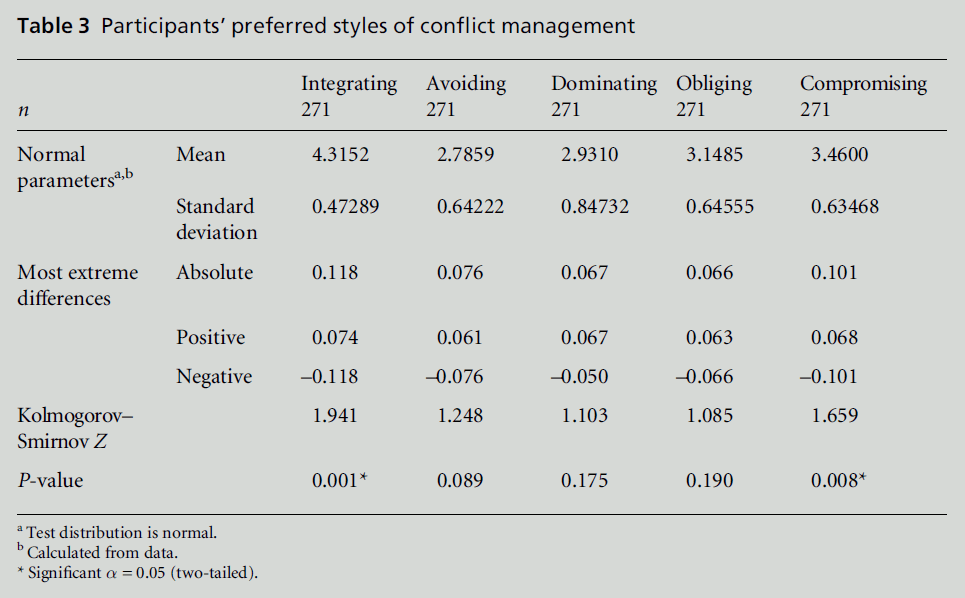
Tabular array 3:ParticipantsÃÆ'¢Â€Âââ€Å¾Â¢ preferred styles of conflict direction.
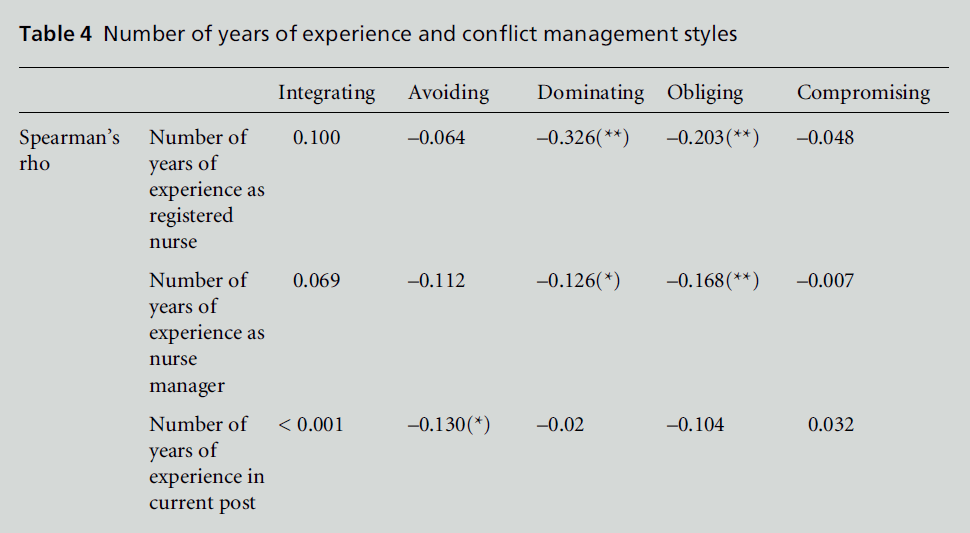
Table 4:Number of years of experience and conflict management styles.
Disharmonize management styles and gender
The Mann–Whitney U-examination was used to decide possible differences between male and female person nurse managers with regard to conflict management styles. Nurse managers did announced to show different preferences according to gender. Male nursemanagers favoured compromising, dominating, obliging, integrating and avoiding styles, in that order. Female nurse managers, on the other hand, preferred avoiding, integrating, obliging, dominating and compromising styles, in that order. Thus the preferred styles for the two genders are the direct contrary of each other. There was no pregnant departure between the genders with regard to the mean score for each style, except for compromising manner.
Conflict management styles and nationality of the participants
The conflict direction styles of nurse managers appeared to differ co-ordinate to their nationality. Omani managers preferred dominating, obliging, integrating, compromising and avoiding styles, in that social club. Jordanian managers preferred compromising, dominating, integrating, obliging and avoiding styles, in that order. Indian managers preferred avoiding, obliging, integrating, compromising and dominating styles, in that social club. Filipino managers preferred integrating, fugitive, compromising, obliging and dominating styles, in that gild.
Disharmonize management styles and nursing qualifications
The Kruskal–Wallis test was used to determine the human relationship betwixt conflict direction styles and nursing qualifications. The results (see Table 5) indicated thatmanagers withMasters and Bachelors degrees in nursing with specialised diplomas preferred the compromising style. Diploma holders preferred the dominating way. Managers with a Bachelors degree in nursing preferred the integrating style.
Conflict management styles and nursing direction level
There was a pregnant difference in preferred conflict management way between nurse managers according to their management level. The obliging manner was the kickoff selection among get-go-level (basic grade) nurse managers and the last choice amongst top-level managers, whereas the integrating style was the first choice amid meridian-level managers and the concluding choice amongst beginning-level nurse managers. Middle-level managers preferred the integrating style, and the obliging style was their last choice.
Conflict management styles and marital condition
There was a significant departure in the use of the obliging style past managers co-ordinate to their marital status (P = 0.041). This is not pregnant according to the revised alpha level. Widows and divorcees preferred the integrating fashion, and only used the obliging style when absolutely necessary. Single and married participants did not show specific manner preferences, although marital status had a significant effect on obliging style (P = 0.041).
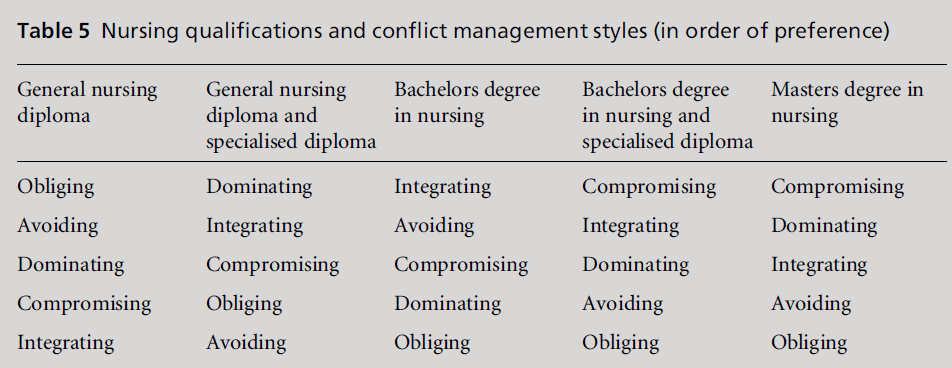
Tabular array five:Nursing qualifications and conflict management styles (in order of preference).
Discussion
Culture and conflict management styles
Four nationalities – Omani, Jordanian, Indian and Filipino – were included in the analysis, because the other nationalities were not well represented in the sample. The preferences with regard to conflict direction manner were different for each nationality. In his study of cultural consequences, Hofstede (2001) combined all of the Arab countries and dealt with them every bit 1 state with the same culture. Oman and Jordan are Arab countries that share the same culture, language and religion, and the culture in eachof the two countries is regarded as a subculture of the main Arab culture. The enquiry reported hither shows that nurse managers from each of the two nationalities had dissimilar preferences for conflict management style, although it is acknowledged that Jordanians in Oman were not in their own land. The findings of this written report make a reasonable instance for the effect of subcultures on conflict management style. Subculture, as divers past values, was as potent a predictor of disharmonize management style as organisational size and respondent age and gender. These findings extend Hofstede'due south (2001) argument that national culture influences organisational behaviour. Like differences in national cultures, differences among subcultures of the same country significantly influence conflict behaviour in organisations.
This research is not supported by previous studies conducted in Oman and Hashemite kingdom of jordan (Al Bawab, 1986; Qatan, 2001; Al Belbeisi, 2003; Harem, 2003; Dmour, 2004). Omani nurse managers preferred dominating and obliging styles, whereas Jordanian nurses preferred compromising and dominating styles. This finding is related to many factors. Most Omanis occupy the post of nurse director without being designated for that postal service. They therefore tend to boss their subordinates in order to control the department, and use the obliging mode with the administrative staff and their supervisors in order to secure their positions. This blueprint reflects the authoritarian tone of administration in Sultanate of oman, and the part of collectivism in suppressing competition among peers. Moreover, frank chat is non easy in a order that has high ability differentials. Nether such conditions, people are ever careful about what they say and how they say it. In improver, Kozan and Ergin (1999) maintain that individuals who used the controlling style had stronger ability values. Their mode could exist indicative of a want to suit their peers and supervisors in order to secure positions in the company. In Arab culture, the individual must respect family elders and defend the family. The elders, in render, are expected to settle disputes. Growing up in a potent family-oriented culture is an emotionally rich and satisfying feel. Children receive attending from their parents and other family members and spend much fourth dimension with them. Individuals are therefore deeply embedded in their 'in-groups', and their private identities are defined in the context of these groups. As a event, there is a cost attached to the support received from the in-group. The private has to be careful not to disappoint the other members, and to satisfy the other members' expectations. In the context of nursing, supervisors have to maintain skilful relationships and secure their post.
The Jordanian nurse managers who were recruited to Oman were on a college calibration grade and received the highest bacon of all the nurses. Most, if not all of them had many years of experience and at least a Bachelor's degree in nursing. The Jordanian nurse managers who were working in Oman focused on improving nursing care, and planned to stay a long time, and therefore used compromising as a preferred style of conflict management. Kozan (1989) constitute that Jordanian managers were mainly compromising with peers. Valentine (2001) pointed out that the frequent use of the compromising style indicates a primary focus on the practical aspects of care.
Integrating was the third preference for conflict management style used by Omani and Jordanian nurse managers.This finding is non supported by the literature, every bit all previous studies conducted in both countries establish this style to be the participants' first choice (Al Bawab, 1986; Qatan, 2001; Al Belbeisi, 2003; Harem, 2003; Dmour, 2004). This difference relates mainly to the fact that the previous research was conducted in the field of education, where the participants did non have to bargain with emergencies and life and death situations, so had time for negotiation and discussion to attain agreement and solve issues. It seems that the nurse managers in this study used an integrating fashion if there was a human relationship or personal conflict that was not related to work or that was not affecting a patient's life and quality of nursing care.
Compromising was the fourth preference for conflict management style used by Omani nurse managers, whereas it was the second selection for the participants in a study by Qatan (2001). In both studies, compromising was the next preferred style after integrating. A compromising style is used equally a back-up to a dominating style.
Indian and Filipino nurse managers used different conflict management styles to Jordanian and Omani nurse managers. Filipino nurse managers seemed to prefer the integrating style, which was not unexpected given that they had earned a reputation for having a strong work ethic, beingness persistent and effective team players, always following directions, having excellent clinical skills and rarely complaining (Yu Xu and Davidhizar, 2004). The avoiding style was the first selection and obliging was the second selection for Indian nurse managers, while avoiding was the second choice for the Filipino nurse managers and obliging was their fourth choice. The majority of Indian nurse managers were recruited to Sultanate of oman equally staff nurses, and afterward many years of feel they were promoted to work as nurse managers. Some of them still had the designation of staff nurse, and therefore they used an obliging manner with their managers and an avoiding style with their peers. Indian and Filipino nurse managers were highly concerned for the other. Valentine (2001) referred to the frequent use of the avoiding style, linking this with the sense of powerlessness associated with the nurse manager's role. Furthermore, a loftier level of concern for others is most probable to occur when at that place is an expectation of a long-term dependency on the other political party. This finding is supported by the literature. Yu Xu and Davidhizar (2004) country that Asian nurses, including Filipino and Indian nurses, who have a primarily communal mentality tend to use fugitive, obliging and integrating styles of conflict management to maintain interpersonal harmony. Asians are socialised into respecting potency, whether it exist heads of households, community leaders, or managers and administrators in the workplace (Valentine, 2001).
Ting-Toomey et al (2000) noted that Latino and Asian Americans tended to use obliging and avoiding styles. Those authors argued that Latino and Asian-American cultures do non perceive these styles equally negative, and went on to state that obliging and avoiding styles are non understood identically in all cultures. Asians, different individuals from Western cultures, do not view obliging and avoiding styles negatively. Compromising is the 4th selection of conflict management manner among Indian nurse managers and the third choice among Filipinos. A dominating mode is the final choice of Indian and Filipino nurse managers, also as for the participants in the studies by Woodtli (1987), Cavanagh (1988, 1991), Barton (1991), Eason (1999) and Kunaviktikul et al (2000). Less use of the dominating way is related to less power. Nurse managers feel that they practice not take the power to apply this fashion considering most Indian nurse managers do non take the designation of nurse manager. Both Indian and Filipino nurse managers feel that because they are in Oman temporarily, Omani nurses may mayhap take over their roles at any time. Thus civilization does play a office in determining a person'due south pick of conflict resolution strategy.
Despite the extant literature on strategies of conflict resolution, nigh of the studies that have investigated the effects of culture and personality take addressed these separately. To appointment, most of the research examining the impact of culture on conflict resolution styles has been washed using the standard cultural variables of individualism–collectivism, power distance, masculinity– femininity, and short-term–long-term orientation as outlined by Hofstede (1983). Withal, in this inquiry, all 4 nationalities are regarded as collectivist, and the conflict management styles are measured using tools adult in Western civilization. There is no evidence regarding understanding of the aforementioned terms and no inquiry into whether or not each nationality uses the aforementioned way in their own land. More studies need to be carried out to determine whether the same disharmonize management styles are used by nurse managers in their own countries, and to decide whether they utilise the same styles in other countries.
Gender and conflict management
The study findings show that gender may influence a nurse manager'south selection of conflict management mode. To appointment, findings relating to gender and preferences for conflict management behaviour have been inconsistent. Some studies take produced testify supporting such gender stereotypes, as women rely more than on harmony-enhancing choices of style, selecting the avoiding manner equally their commencement choice (Cavanagh, 1988; Cavanagh, 1991; Eason, 1999; Valentine, 2001). However, there is other prove that shows no pregnant differences with regard to gender and preferences for item conflict management styles (e.thousand. Ting-Toomey et al, 2000). Woodtli (1987) and Hendel et al (2005) found that female nursing managers used compromising as their first selection of style. Other researchers have institute that women use a cooperative style more often than their male counterparts (Levine and Feldman, 1997); inquiry conducted in Arab countries has as well yielded different findings. Qatan (2001) found that Omani men used avoidance more than women, but this was the just divergence. Al-Bawab (1986) besides plant that female Jordanian principals were more compromising and less obliging than their male counterparts, while gender had no effect in the other studies (Al-Belbeisi, 2003; Harem, 2003; Dmour, 2004). In the present study, female nurse managers used avoiding every bit their preferred conflict direction style, as did the participants in the studies by Cavanagh (1988, 1991), Eason (1999) andValentine (2001). For male managers a compromising fashion was their first selection, whereas for female person managers this style was their concluding choice.
Viewed from the perspective of gender, the process by which women are socialised encourages them to build relationships and to bring people together, non to bulldoze them apart. Women are generally culturally trained to bemore concerned with interpersonal aspects of relationships than are men, often subordinating their ain interests, preferences and needs to those of others. Generally speaking, information technology is believed that cooperativeness is more characteristic of women and assertiveness is more than representative of the traits that men possess. Therefore information technology is not surprising to find that the female nurse managers in this study preferred an avoiding style followed past a collaborating way, whereas the male nurse managers preferred a compromising style followed past an integrating style.
Female nurses tend to view the handling of conflict as a way to seek affirmation and support while too attempting to maintain harmony (Valentine, 2001). Because nurse managers work in contexts in which they are unlikely to occupy the most powerful positions, the choice of disharmonize direction styles may, in part, be based on the powerlessness associated with these positions. Women have been accustomed to depend on others in lodge to meet their emotional needs, and to value support. Conflict is seen as a distancing behaviour that may result in rejection.
Nursing teaching and conflict management
This study institute that nursing education has an consequence on conflict management styles. At that place was a significant difference between compromising (P = 0.019), obliging (P = 0.003), dominating (P = 0.006) and integrating (P = 0.033) styles. Inquiry findings on the event of educational level on preferences for conflict management styles have been inconsistent. Qatan (2001), Dmour (2004) and Hendel et al (2005) found that educational level played no significant role in the choice of such styles. On the other paw, Harem (2003) observed a human relationship between educational level and the dominating and avoiding styles. This written report plant that nursing education has an consequence on conflict management styles. Nurse managers with a diploma caste in nursing preferred obliging and avoiding styles, because they felt powerless. Individuals may believe that noesis confers power. This belief might cause someone with a diploma degree to experience powerless by comparison with an individual with a university or specialised caste. Those with diploma degrees are in nursing direction posts without the appropriate designation, and therefore they attempt to oblige their supervisors and avoid conflict because they have no cognition of disharmonize management styles. The specialised nursing diploma is a one-year grade, and nursing direction is one of the specialised diplomas offered in Oman. Students are taught conflict management strategies during this course. When such a student obtains a specialised diploma, they volition be in charge of departments, secure in their management position, and more knowledgeable than other members of staff. The majority of nurses with Bachelor degrees who participated in this written report were not-Omani, and nationality plays a role in the selection of conflict direction style. The Omani nurse managers with Masters degrees mainly graduated fromUS institutions, and in addition to possessing qualifications that are considered to exist the highest in the nursing profession in Oman, they are now also in the top nursing posts.
Management level and conflict management styles
It seems that nurse managers at the three direction levels used all of the conflict management styles, but in different orders of preference. In that location is a significant difference betwixt the integrating, dominating and obliging styles. Previous research yielded conflicting findings regarding the issue of management levels on the choice of conflict management styles. Chusmir and Mills (1989) plant no effect, whereas Barton (1991) reported that assistant heads of nursing used an avoiding style more than than nurses at the other two direction levels, and that nurse administrators used a competing way as their 2d choice, while for banana heads and heads of nursing a competing style was their last option. Harem (2003) showed that first-level department heads used the avoiding style more than than administrators did. Start-level nurse managers used the obliging and dominating styles as their first two choices, which may exist due to the fact that their entry-level direction position places them in the role of subordinate more oftentimes than is the case for the other two management groups. This means that they tend to oblige their supervisors and dominate their subordinates.
The top-level nurse managers accept managerial positions in nursing departments and they report to the chief executive officeholder. Information technology is therefore not unexpected that they used the integrating manner with subordinates from the nursing staff to get work done. At the same time they used the compromising mode with the assistants. From the nowadays researcher'southward experience, when the administration asks them to move nurses they enquire for some return for nursing. For example, they will hold to transfer a particular nurse to the laboratory or X-ray department if they are given 1 medical orderly.
Marital status and disharmonize management styles
The effect of marital status on the obliging manner is clear. Previous research has plant no event of marital status on conflict management styles. Married nurses, especially women, who represented the bulk of participants in this report, preferred the avoiding and obliging styles. As the majority of nurses are women, they have a decorated domicile life and a large amount of domestic responsibleness, so they effort to avoid conflict at piece of work so that their domicile lifewill non be affected by this.
Age and number of years of feel
At that place is a negative relationship between historic period and number of years of experience as registered nurse on the one hand, and the obliging and dominating styles on the other. Previous nursing research has found no result of age on conflict management styles, although Harem (2003) found a negative relationship between the fugitive fashion and age, and a positive relationship between the dominating style and age. Cetin and Hacifazhoglu (2004) plant a positive relationship between age and the integrating manner. Age is a very of import source of respect in traditional Arab lodge, and provides legitimacy and credibility for intervention in social conflict, regardless of the nature of the dispute (Abu-Nimer, 1996). In Arab countries, the historic period of a person is the one factor that commands respect regardless of their educational level or role in the organisation.
A negative relationship was constitute betwixt experience in the current postal service and the avoiding style. In previous research, Hendel et al (2005) found that the longer nurse managers were in position, the more than they used the collaborating style. The negative relationship between the avoiding style and experience in the electric current post was related to the effect of poor disharmonize management on the departments' outcomes. The longer nurses stay in postal service, the less they will exist able to avoid daily conflict, considering any conflict that is avoided volition reappear and volition eventually affect the working environs. They therefore know that they must try to manage the disharmonize directly rather than ignore information technology.
Recommendations
Research is needed to establish the cultural meanings of the 5 conflict management styles. Studies can decide whether these meanings are understood differently by people from communalist and individualist cultures, as well as by diverse sub-cultural groups.
Future research could also constitute new, standardised instruments for assessing conflict management way, which would eliminate whatever cultural biases. These instruments could and then be used to accurately measure differences in direction styles between cultures, when nurses from different cultural regions are participating in a study.
Further inquiry is needed to explore the conflict management styles used by nurse managers in the countries whose nationals took function in this written report, in order to find out whether they use different styles when working in their own countries.
Decision
Nurse managers work in an environment where conflict is probable to occur and can be difficult to manage because of the different means in which participants view information technology, peculiarly when they are from dissimilar cultures, of different genders, and have dissimilar nursing qualifications. At that place is a need to empathize conflict management from the perspectives of nurse managers. This understanding would ameliorate nurses' evaluation of how to handle conflict situations. Conflict management styles that incorporate nurse managers from unlike cultures and of both genders volition aid to balance the knowledge base with regard to organisational, cultural multifariousness and authoritative aspects of the nursing literature. Gaining insight into the values of culture and gender could help nurse managers to better empathize conflict management styles using different perspectives, and thereby enhance the surroundings of nursing organisations.Most studies of conflict management styles take been conducted in Western countries. This study goes further past examining disharmonize management styles inside an Arab state, and it shows how, in that setting, nurse managers at unlike levels in the organization, from different cultures and with different qualifications, manage disharmonize.
Acknowledgment
The author would like to thank Professor Denis Anthony and Dr Raghda Shukri for their assist in preparing this written report by providing supervision and statistical advice during the completion of a PhD thesis, on which this paper is based.
CONFLICTS OF INTEREST
None.
References
- Abu-Nimer M (1996) Conflict resolution approaches: westernand Eye Eastern lessons and possibilities.American Journal of Economics and Sociology 55:35ÃÆ'¢Â€Ââ€Å"44.
- Al-Bawab H (1986) Conflict direction styles used bysecondary academic school principals in Jordan. UnpublishedMSc thesis, Hashemite kingdom of jordan Academy, Amman, Hashemite kingdom of jordan (inArabic).
- Al-Belbeisi S (2003) Conflict direction styles used by publicsecondary school principals in Jordan and their relationshipto teachersÃÆ'¢Â€Âââ€Å¾Â¢ morale and organisation commitment. UnpublishedPhD thesis, Standard arabic University for Graduate Studies,Amman, Jordan (in Arabic).
- Bartol GM, Rebecca P and Maryellen M (2001) Effectiveconflict management begins with knowing your style.Journal for Nurses in Staff Development 17:34ÃÆ'¢Â€Ââ€Å"40.
- Barton A (1991) Conflict resolution by nurse managers.Nursing Management 22:83ÃÆ'¢Â€Ââ€Å"6.
- Blake R and Mouton J (1964) The Managerial Grid: keyorientations for achieving production through people.Houston, TX: Gulf Publishing.
- Blake R and Mouton J (1985) The Managerial Grid 3.Houston, TX: Gulf Publishing.
- BoonsathornW (2003) Competence is in the eye of thebeholder: disharmonize management styles and perceived competenceof disharmonize direction styles by Thais andAmericans in multinational corporations in Thailand.Unpublished PhD thesis, Pennsylvania Land University,University Park, PA.
- Campbell One thousand (2003) The efficacy of conflict-mediation trainingin elementary schools. Educational Forum 67:148ÃÆ'¢Â€Ââ€Å"55.
- Cavanagh S (1988) The conflict management style of intensivecare nurses. Intensive Care Nursing four:118ÃÆ'¢Â€Ââ€Å"23.
- Cavanagh S (1991) Conflict management mode of staff nursesand nurse managers. Journal of Advanced Nursing16:1254ÃÆ'¢Â€Ââ€Å"lx.
- Cetin OM and Hacifazhoglu O (2004) Conflict managementstyles: a comparative study of academy academics andhigh schoolhouse teachers. Journal of the American Academy ofBusiness 5:325ÃÆ'¢Â€Ââ€Å"32.
- Chusmir L and Mills J (1989) Gender differences in conflictresolution styles of managers: at work and at home. SexRoles 20:149ÃÆ'¢Â€Ââ€Å"63.
- De Dreu CK and Van De Vliert E (1997) Using Conflict inOrganizations. London: Sage.
- De Dreu C, Evers A, Beersma B et al (2001) A theory-basedmeasure of conflict management strategies in the
- workplace. Journal of Organizational Beliefs 22:645ÃÆ'¢Â€Ââ€Å"68.
- Dmour S (2004) Methods used by the educational supervisorin Hashemite kingdom of jordan when dealing with organizational conflict. UnpublishedMSc thesis, Mutah Academy, Karak, Jordan(in Arabic).
- Eason FR (1999) Conflict management: assessing educationalneeds. Journal for Nurses in Staff Development15:92ÃÆ'¢Â€Ââ€Å"6.
- Elsayed-Ekhouly South and Buda R (1996) Organizational conflict:a comparative analysis of disharmonize styles across
- cultures. International Journal of Conflict Management7:71ÃÆ'¢Â€Ââ€Å"81.
- EnnamiAK(1996) Al-Ibadhiyah. Muscat: Ministry of Awqafand Religious Affairs.Forte PS (1997). The high price of conflict. Nursing Economics15:119ÃÆ'¢Â€Ââ€Å"23.
- Harem H (2003) Conflict resolution at the commercialbanks in Hashemite kingdom of jordan. Jordanian Journal for Applied Sciences6:47ÃÆ'¢Â€Ââ€Å"67 (in Arabic).
- Hendel T, Fish M and Galvon V (2005) Leadership style andchoice of strategy in conflict management amongst Israelinurse managers in general hospitals. Journal of NursingManagement 13:137ÃÆ'¢Â€Ââ€Å"46.
- Hofstede Yard (1983) National cultures in four dimensions: aresearch-based theory of cultural differences amongnations. International Studies of Management and Organization8:46ÃÆ'¢Â€Ââ€Å"74.
- HofstedeG(2001) CultureÃÆ'¢Â€Âââ€Å¾Â¢southward Consequences: comparison values,behaviors, institutions, and organizations beyond nations.Thousand Oaks, CA: Sage.
- Hurst JB and KeenanGM(2000) Disharmonize: the cutting border ofchange. In: Yoder-Wise P (ed.) Leading and Managing inNursing. New York: Mosby.
- Jameson JK (1999) Towards a comprehensive model for theassessment and direction of intra-organizational conflict:developing the framework. International Periodical ofConflict Management 10:268ÃÆ'¢Â€Ââ€Å"94.
- Keenan Thou, Cook R and Hillis S (1998) Norms and nursemanagement of conflict: keys to agreement nurseÃÆ'¢Â€Ââ€Å"medico collaboration. Research in Nursing and Health21:59ÃÆ'¢Â€Ââ€Å"72.
- Kozan MK (1989) Cultural influences on styles of handlinginterpersonal disharmonize: comparisons among Jordanian,Turkish, and US managers. Homo Relations 42:787ÃÆ'¢Â€Ââ€Å"99.
- Kozan MK (2002) Subcultures and conflict managementstyle. Management International Review 42:89ÃÆ'¢Â€Ââ€Å"105.
- Kozan MK and Ergin C (1999) The influence of intraculturaldifferences on conflict management styles. InternationalJournal of Conflict Direction 10:249ÃÆ'¢Â€Ââ€Å"67.
- Kramer RM (1989) Windows of vulnerability or cognitiveillusions? Cognitive processes in the nuclear arms race.Journal of Experimental Social Psychology 25:79ÃÆ'¢Â€Ââ€Å"100.
- Kunaviktikul W, Nuntasupawat R, SrisuphanWet al (2000)Relationships among conflict, conflict direction, jobsatisfaction, intent to stay, and turnover of professionalnurses in Thailand. Nursing and Health Sciences 2:9ÃÆ'¢Â€Ââ€Å"xvi.
- Levine SP and Feldman RS (1997) Cocky-presentational goals,self-monitoring, and nonverbal behaviour. Bones andApplied Social Psychology xix:505ÃÆ'¢Â€Ââ€Å"xviii.
- McElhaney R (1996) Conflict management in nursingadministration. Nursing Management 24:65ÃÆ'¢Â€Ââ€Å"6.
- Marriner TA (1982) Managing conflict. Nursing Management13:29ÃÆ'¢Â€Ââ€Å"31.
- Ministry of Health (2006) Annual Health Written report 2005.Muscat: Ministry of Health; world wide web.moh.gov.om/nv_menu.php?fNm=stat/HStatMOH.php (accessed 28 August2008).
- Ministry of National Economy (2004) Concluding Results of theCensus 2003; www.omancensus.internet/english/pdf_files/
- final_results.pdf (accessed 17 September 2008).
- Pondy LR (1967) Organizational disharmonize: concepts andmodels. Administrative Science Quarterly 12:296ÃÆ'¢Â€Ââ€Å"320.
- Qatan T (2001) Organizational disharmonize management stylesamong secondary school principals in the Sultanate ofOman. Unpublished MSc thesis, Sultan Qaboos Academy,Muscat, Oman.
- Rahim AM (1983) A mensurate of styles of treatment interpersonalconflict. Academy of Direction Journal 26:368ÃÆ'¢Â€Ââ€Å"76.
- Shockley-Zalabak P (1981) The effects of sex differences onthe preferences for utilization of disharmonize styles of managersin a work setting. Public Personnel ManagementJournal 10:289ÃÆ'¢Â€Ââ€Å"95.
- Tabak N and Koprak O (2007) Relationship between hownurses resolve their conflicts with doctors, their stress andjob satisfaction. Journal of Nursing Direction xv:321ÃÆ'¢Â€Ââ€Å"31.
- Tengilimoglu D and Kisa A (2005) Conflict management inpublic university hospitals in Turkey: a pilot study. HealthCare Manager 24:55ÃÆ'¢Â€Ââ€Å"60.
- Thomas KW and Kilmann RH (1974) Thomas-KilmannConflict Way Instrument. Mountain View, CA: Xicomand CPP, Inc.
- Ting-Toomey South, Yee-Jung KK, Shapiro RB et al (2000)Indigenous/cultural identity salience and conflict styles infour The states ethnic groups. International Journal of InterculturalRelations 24:47ÃÆ'¢Â€Ââ€Å"81.
- Valentine PE (2001) A gender perspective on conflict managementstrategies of nurses. Journal of Nursing Scholarship33:69ÃÆ'¢Â€Ââ€Å"74.
- Vivar CG (2006) Putting conflict management into practice:a nursing case report. Journal of Nursing Management14:201ÃÆ'¢Â€Ââ€Å"6.
- Woodtli A (1987) Deans of nursing: perceived sources ofconflict and conflict-handling modes. Periodical of NursingEducation 26:272ÃÆ'¢Â€Ââ€Å"7.
- Yu Xu and Davidhizar R (2004) Conflict direction stylesof Asian and Asian American nurses. Health Intendance Manager23:46ÃÆ'¢Â€Ââ€Å"53.
Source: https://www.primescholars.com/articles/nurse-managers-diversity-and-conflict-management-94675.html
0 Response to "â€å“to Resolve a Conflict First Decide Is It Hot or Cold?ã¢â‚¬â Harvard Business Review"
Postar um comentário